Categories
Blog

When the Betrayal Is Twice as Hard: When They Leave You for a Friend

Breakups hurt.

But when your partner leaves you for a close friend, it hits differently.

You don’t just lose a relationship.
You lose two people.
And often, your sense of safety with them both.

That’s what makes this kind of betrayal uniquely destabilising.

It’s Not Just Heartbreak – It’s Exposure

When someone leaves you for a stranger, it’s painful.

When they leave you for someone you trusted, it can feel humiliating.

You may find yourself thinking:

  • How long was this happening?
  • Did everyone else know?
  • Was I the only one in the dark?
  • Was I foolish to trust them both?

It can feel like the ground has shifted beneath you – not just emotionally, but socially. Shared circles, mutual friends, family events – everything feels complicated.

The pain isn’t just private. It can feel public.

The Real Damage: Self-Doubt

The hardest part for many people isn’t losing the partner.
It’s losing trust in their own judgement.

You trusted your friend.
You trusted your partner.
You believed the boundaries were clear.

Now you’re questioning your instincts.

That self-doubt can linger long after the relationship ends.

And for capable, intelligent people – which many of my clients are – that loss of self-trust is often the deepest wound.


You Are Not “Naive”

There is often quiet shame in this situation.

Embarrassment.
Comparison.
A sense of being replaced.

But trust is not stupidity.
Believing in people is not weakness.
Expecting loyalty is not unrealistic.

Two people made choices that crossed boundaries.
That responsibility does not belong to you.


The Secondary Loss: Your Social World

When betrayal involves a friend, it rarely ends cleanly.

You may lose an entire social circle.
You may withdraw to avoid awkwardness.
You may become guarded in new friendships.

This is where people start shrinking themselves – not because they want to, but because they no longer feel safe.

And that’s understandable.

But it doesn’t have to be permanent.


What Recovery Actually Looks Like

Healing from this kind of betrayal isn’t about pretending it didn’t matter.

It’s about rebuilding three things deliberately:

  1. Your self-trust
    • Learning to trust your instincts again, without becoming cynical.
  2. Your boundaries
    • Getting clear on what is and isn’t acceptable going forward.
  3. Your identity
    • Separating your worth from someone else’s decision.

You don’t need to rush forgiveness.
You don’t need to explain yourself.
And you don’t need to “be the bigger person” before you’re ready.


A Hard Truth

Sometimes people who leave for a friend want the comfort of familiarity without the courage of honesty.

That doesn’t make you inadequate.
It makes them avoidant.

What happened says more about their integrity than your value.

Something to Consider

If this has happened to you, ask yourself:

  • What story am I telling myself about my worth?
  • Would I say that story to someone I care about?
  • What boundaries would protect me better next time?
  • What would rebuilding self-trust look like in small steps?

You don’t need to become harder.
You need to become clearer.

And clarity is something you can rebuild.

Categories
Blog

Valentine’s Day When You’re Not Okay

Valentine’s Day can feel very different depending on where you are in your relationship.

For some, it’s light and joyful.
For others, it’s heavy.

And if you’re going through a breakup, separation, or relationship uncertainty, 14 February can land like a spotlight on everything that feels unresolved.

It’s not just a date in the calendar.
It can feel like a reminder.

When Love Feels Complicated

Valentine’s Day amplifies contrast.

Shops fill with red and pink.
Restaurants advertise couple menus.
Social media becomes a highlight reel of declarations and photos.

If you’re struggling, you may notice:

  • A sudden spike in loneliness
  • Comparison you didn’t expect
  • A sense of being “behind”
  • Anger or resentment
  • Grief for what you thought you’d have by now

Even if you’re usually coping well, days like this can catch you off guard.

And that doesn’t mean you’re weak. It means you’re human.

If You’re Newly Single

If this is your first Valentine’s Day after a breakup, it can feel especially sharp.

You might miss:

  • The routine of exchanging cards
  • The small rituals
  • The sense of being chosen

Even if the relationship wasn’t healthy, the absence of it can still hurt.

Grief doesn’t follow logic.

You can know something wasn’t right and still feel its loss.

If You’re In a Relationship That Doesn’t Feel Secure

Valentine’s Day can also expose what’s already fragile.

If you’re in a relationship that feels distant, uncertain, or strained, this day can highlight the gap between what you want and what you have.

You might find yourself asking:

  • Is this enough for me?
  • Am I settling?
  • Why doesn’t this feel how it used to?

Those questions are uncomfortable – but they’re important.

If You’re Living in Limbo

For those in a no-split divorce or emotional separation, Valentine’s Day can feel particularly surreal.

You may be sharing a home with someone who no longer feels like your partner.

There may be silence where there used to be connection.

In that space, the day can feel artificial – almost performative.

And it’s okay if you choose not to perform.

What Actually Matters on 14 February

Valentine’s Day is marketed as proof of love.

But real love – healthy, steady, emotionally safe love – isn’t proven by a single day.

It’s shown in:

  • Consistency
  • Respect
  • Emotional honesty
  • Boundaries
  • Safety

If those things are missing, flowers won’t fix it.

And if you’re alone right now, that doesn’t mean you’re unlovable. It means you’re between chapters.

A Different Way to Approach This Day

Instead of asking:
 “Who is choosing me?”

You might ask:
 “Am I choosing myself well?”

That doesn’t mean forced positivity or pretending you’re fine.

It means:

  • Not minimising your pain
  • Not comparing your timeline to someone else’s
  • Not staying somewhere that diminishes you
  • Not abandoning your own needs

Valentine’s Day can feel exposing.

But it can also be clarifying.

Sometimes the most important relationship you rebuild after heartbreak is the one with yourself.

If Today Feels Heavy

You don’t need to make big decisions today.
You don’t need to prove anything.
You don’t need to “be over it.”

You just need steadiness.

And steadiness can be rebuilt – quietly, gradually, and without drama.

This day will pass.
But how you treat yourself during it matters.

Categories
Blog

Why January Is Known as “Divorce Month” –  and What to Do If You’re Struggling Right Now

Every year, the first working Monday of January is quietly referred to as “Divorce Day.”
It’s the point when family lawyers, mediators, coaches, and support services see a sharp rise in enquiries.

January as a whole is often called “divorce month.”

Not because relationships suddenly break overnight – but because many have been quietly unravelling for months.

Why So Many Relationships Reach a Breaking Point in January

For many couples, Christmas becomes the final emotional test.

People often:

  • Hold things together “for the children”
  • Avoid difficult conversations over the holidays
  • Push down resentment to get through family gatherings
  • Hope the break will somehow make things feel better

But when January arrives, the distractions are gone.

What’s left is reality – and for many, that reality feels impossible to ignore any longer.

January brings:

  • Emotional exhaustion after months (or years) of strain
  • Financial clarity and practical thinking
  • A strong desire for a fresh start
  • The realisation that “I can’t do another year like this”

This is why January isn’t just a legal turning point – it’s an emotional one.

If This Is You, You’re Not Weak – You’re Human

If you’re feeling overwhelmed, conflicted, or frozen right now, that makes sense.

You might be:

  • Going back and forth between staying and leaving
  • Afraid of making the wrong decision
  • Worrying about the impact on children, finances, or your future
  • Functioning at work while falling apart privately
  • Feeling pressure to “be decisive” when you’re emotionally exhausted

High-functioning professionals often struggle the most – because they’re used to coping, solving, and holding it together.

But breakup and divorce aren’t problems you can logic your way through.
They’re emotional transitions – and they require emotional clarity.

January Decisions Made in Emotional Overload Can Shape Years to Come

This is one of the most important things to understand:

When people make major relationship decisions while overwhelmed, they are more likely to:

  • Act out of fear, guilt, or panic
  • Delay decisions they actually need to make
  • Escalate conflict unnecessarily
  • Make choices they later regret
  • Burn out emotionally before the process has even begun

This is where the right support at the right time makes a profound difference.

Not to push you in one direction – but to help you think clearly, regulate your emotions, and make decisions you can stand by.

You Don’t Have to Decide Everything This Month

January creates urgency – but clarity doesn’t come from pressure.

You don’t need to:

  • Know exactly what you want yet
  • Have all the answers
  • Make irreversible decisions immediately

What you do need is:

  • Space to think clearly
  • Support that isn’t emotionally loaded
  • A place to talk honestly without judgement
  • Help separating fear from intuition

That’s where specialist breakup and divorce support comes in.

How Sea Change Therapy & Coaching Can Help

At Sea Change Therapy & Coaching, I support people at the very beginning of this process – when everything feels uncertain and emotionally charged.

I help clients:

  • Calm emotional overwhelm and anxiety
  • Gain clarity about what they actually want and need
  • Prepare emotionally before legal or financial steps
  • Make grounded decisions instead of reactive ones
  • Protect their wellbeing, confidence, and professional life

This isn’t about telling you what to do.
It’s about helping you feel steady enough to choose well.

If January Has Brought You to a Crossroads

If something in this feels real for you – if you’ve found yourself searching for answers, support, or reassurance – you don’t have to carry it alone.

📩 Book a free, confidential Breakup Discovery Call to talk things through calmly and safely.

This is a space to:

  • Slow everything down
  • Get perspective
  • Understand your options
  • Take one clear next step – without pressure

👉 www.seachangetherapyandcoaching.com

You don’t have to have everything figured out.
You just need a place to start – with clarity, compassion, and support.

Categories
Blog

Should a Financial Planner Be the First Professional You Speak to During Breakup or Divorce?

When a relationship ends, most people instinctively think about two professionals:

A divorce solicitor, to handle the legal process.

And sometimes a financial planner, to understand what the future might look like financially.

What’s far less clear is when each professional is most helpful – and in what order.

For professionals, business owners, and leaders, this matters more than is often recognised.

The timing of support can significantly affect outcomes, costs, and long-term stability.

So should a financial planner be the first person a client engages with during breakup or divorce?

The more accurate question is this:

Is the client emotionally ready to use the advice they’re given?

Why Emotional Readiness Matters More Than Financial Complexity

Breakup and divorce are not just legal or financial events.

They are psychological transitions that affect clarity, judgement, and decision-making.

Even highly capable people can find it difficult to:

  • think long term
  • weigh options calmly
  • separate emotion from strategy

This isn’t a personal failing. It’s a natural response to loss, uncertainty, and change.

Early decisions often shape everything that follows – which is why emotional readiness matters as much as technical expertise.

When Early Financial Planning Is Helpful

A financial planner who specialises in divorce can be invaluable early in the process when the client is emotionally steady enough to engage.

At that point, financial planning can:

  • clarify what is genuinely affordable
  • highlight sustainable housing and income options
  • reduce unrealistic expectations
  • prevent disputes later in the process
  • lower overall legal costs

When the client is calm enough to absorb the information, early financial insight can be protective and empowering.

When Financial Advice Comes Too Soon

When someone is overwhelmed, angry, fearful, or in shock, even excellent financial advice can fail to land.

In these moments, clients may:

  • fixate on keeping the house at all costs
  • prioritise “fairness” over sustainability
  • resist advice that feels threatening to emotional safety
  • make decisions driven by fear or anger rather than logic

When this happens, the numbers aren’t the problem.

The nervous system is.

And when emotional load isn’t supported, it often spills into legal and financial conversations – increasing cost, delay, and frustration for everyone involved.

Why Emotional Support Is Often the Missing First Step

For many clients, the most effective early support is emotional stabilisation, not problem-solving.

This isn’t therapy.

It’s support that helps people:

  • reduce reactivity
  • regain clarity
  • feel grounded enough to think ahead
  • make decisions from a calmer place

This is where specialist Breakup & Divorce Coaching plays a crucial role.

When emotional steadiness comes first:

  • financial advice is better understood
  • legal advice is used more efficiently
  • decisions are less reactive and more sustainable

In practice, this often saves time, money, and emotional energy.

The Most Effective Approach: A Coordinated Support Team

The strongest outcomes usually come from a collaborative model, where each professional works within their expertise:

A Breakup & Divorce Coach supports emotional regulation, clarity, and decision-making capacity

A Financial Planner specialising in divorce translates options into sustainable, real-world outcomes

A Specialist divorce solicitor or mediator focuses on legal structure and resolution

No one role replaces another.

Each works best when the others are doing what they’re designed to do.

So Who Should Be First?

Rather than asking who should come first, a more useful question is:

What does this person need right now to make good decisions?

If the client is calm and emotionally regulated, early financial planning can be extremely helpful.

If the client is overwhelmed or reactive, emotional support first often leads to better financial and legal outcomes later.

There is no single right order – but there is a right sequence for each individual.

A Final Thought

Professionals and leaders are used to building strong advisory teams in every other area of life.

Breakup and divorce deserve the same level of care.

Not because clients are incapable – but because even the most capable people struggle to think clearly when something this personal shifts.

The goal isn’t speed.

It’s sustainability.

And that’s achieved best when the right support is brought in at the right time.

Categories
Blog

How HR Leaders Can Support Employees Going Through Divorce or Separation

Divorce and separation are among the most emotionally disruptive life events anyone can experience.
Yet while most organisations have policies for bereavement, sickness, or parental leave, few have a plan for supporting employees through the impact of relationship breakdown.

That gap matters. Because even your most capable, high-performing people can struggle to function when their personal life is falling apart – and the effects show up quietly but powerfully at work.

The Hidden Impact on Work and Wellbeing

The stress of divorce affects far more than home life.
Sleep disappears. Concentration fades. Confidence and decision-making falter.

Employees may still appear to be coping, but behind the scenes:

Deadlines slip.

Communication becomes reactive.

Emotional triggers spill into meetings.

Motivation and focus decline.

Research consistently shows that divorce can reduce productivity by up to 40% and increase stress-related absence for months afterwards.

For HR leaders, this isn’t a private matter – it’s a wellbeing, engagement, and retention challenge.

Why Divorce Belongs on the Workplace Wellbeing Agenda

Divorce affects every dimension of working life: cognitive, emotional, financial, and social.

Employees navigating separation often experience:

Heightened stress and anxiety

Financial strain and legal pressures

Disrupted sleep and poor concentration

Difficulty balancing parenting with work demands

When organisations ignore this, the struggle doesn’t disappear – it simply goes underground.
When they acknowledge and support it, people recover faster, stay engaged, and remain loyal.

Five Ways HR Leaders Can Help
1️⃣ Recognise Divorce as a Legitimate Wellbeing Issue

Acknowledge it openly. Treat separation as a major life stressor, not a personal failure.
That recognition alone reduces stigma and builds trust.

2️⃣ Equip Managers for Compassionate Conversation

Most managers want to help but don’t know how.
Offer simple guidance on listening with empathy while maintaining professional boundaries.
Even a line like,

“Thank you for letting me know – let’s explore what support might help right now,”
can be transformative.

3️⃣ Offer Flexibility Where Possible

Short-term flexibility – hybrid working, adjusted deadlines, or leave for legal or parenting transitions – can prevent burnout and disengagement.
It’s not indulgence; it’s practical compassion.

4️⃣ Provide Emotional Support Pathways

Legal and financial advice are vital, but emotional regulation determines whether people can use that advice effectively.
Partnering with a breakup and divorce coach offers confidential, focused emotional support that complements your internal wellbeing offer.
It helps employees regain stability, clarity, and professionalism faster.

5️⃣ Model a Culture of Humanity

When leaders show compassion for life’s hardest moments, they build loyalty that no policy can buy.
Supporting someone through crisis strengthens both culture and reputation – proving that empathy and performance are not opposites.

The ROI of Empathy

Organisations that handle personal transitions well see measurable benefits:
✅ Reduced absenteeism and presenteeism
✅ Faster recovery of productivity
✅ Higher engagement and morale
✅ Stronger employer brand and trust

Empathy is not “soft.” It’s strategic.
People perform better when they feel safe and supported – especially when life outside of work feels uncertain.

Partnering with Sea Change Therapy & Coaching

At Sea Change Therapy & Coaching, I work with HR and wellbeing leaders to help employees navigate the emotional impact of divorce or separation – so they can stay balanced, communicative, and productive.

Together, we:

Provide structured emotional support alongside legal and financial processes

Help employees regulate stress and rebuild focus

Equip managers with confidence to respond appropriately

Strengthen wellbeing culture and retention

If your organisation is ready to support employees through significant personal change, I’d love to collaborate.

📩 Book a short introductory call or request a digital partnership pack at
👉 www.seachangetherapyandcoaching.com

When workplaces recognise that personal change is professional change, everyone benefits.


Categories
Blog

When You’re the One Who Left: Guilt, Grief, and the Hidden Side of Moving On

People often assume the person who ends a relationship walks away lighter.
But anyone who’s ever had to make that choice knows it’s rarely easy – and never pain-free.

Even when you know it was the right thing to do, the guilt can cut deep.
You might feel relief one moment, heartbreak the next.
You might wonder:

“Did I try hard enough?”
“Was I selfish?”
“What if I’ve made a mistake?”

Leaving doesn’t spare you from grief.
It just gives you a different version of it.

The Quiet Weight of Being the One Who Left

When you end a relationship, it can feel like you’ve lost the right to be sad.
You tell yourself you “should be fine” – after all, you made the decision.

But grief doesn’t care who left first.
You’re still saying goodbye to what was familiar, and to the person you hoped things could become.

You might carry:

Guilt for hurting someone you once loved

Shame for wanting more or needing to go

Anger that you had to be the one to make the hard call

Loneliness, even though you were the one who said goodbye

It’s a confusing mix – guilt and relief, sadness and freedom, love and loss – all existing at once.

Guilt Isn’t Proof You Were Wrong

Feeling guilty doesn’t mean you made a mistake.
It means you care.

You cared enough to try. You cared enough to think about how your decision would affect them.
But sometimes, staying would have meant betraying yourself.

The truth is:
You can still love parts of someone and know you can’t keep living the same story.
You can miss them and still be right to leave.

Both can be true.

What You’re Really Grieving

When clients tell me, “I left, but I still feel broken,” what they’re grieving is usually more than the person.

They’re grieving:

The future they imagined

The comfort of routine

The version of themselves who still believed it could work

That’s real loss – and it deserves compassion, not shame.
You don’t need permission to feel pain about something you chose to end.

How to Move Forward Without Punishing Yourself

You can’t outthink guilt or rush through grief.
But you can work with them in ways that help you heal.

1️⃣ Stop apologising for your emotions.

You’re allowed to miss someone you couldn’t stay with.
You’re allowed to feel sad and sure.
Your emotions don’t need defending – they need space.

2️⃣ Remember why you left.

When guilt surfaces, go back to the truth that made you walk away.
Write it down if you need to. Clarity steadies you when nostalgia distorts things.

3️⃣ Take responsibility – not all the blame.

You can own your part in what happened without carrying the whole story. Healing isn’t about self-punishment; it’s about self-understanding.

4️⃣ Seek grounded support.

Friends often take sides.
A professional helps you make sense of the emotions so you can rebuild confidence and peace without judgement.

Letting Go of the Old Story

Leaving doesn’t make you the villain.
It makes you honest – with yourself and with them.

Sometimes love means recognising when staying would cause more harm than leaving.
You don’t owe anyone endless suffering to prove your care was real.

You’re allowed to heal too.
This chapter can end not with guilt, but with gratitude – for the lessons, the growth, and the courage it took to choose truth over comfort.

When You’re Ready to Heal

If you’ve left a relationship and can’t seem to shake the guilt or “what ifs,” you don’t have to face it alone.

At Sea Change Therapy & Coaching, I help people navigate the emotional complexity of separation – whether they were left or they left – with compassion, perspective, and practical tools to move forward.

📩 Book a free, confidential Breakthrough Session to talk about what’s next for you.
👉 www.seachangetherapyandcoaching.com

You can care deeply and still walk away.
You can grieve and still grow.
And you can heal – even when you were the one who said goodbye.

Categories
Blog

When Closure Never Comes: Healing Without the Answers You Wanted

Some endings don’t come with explanations.
You’re left replaying every moment, wondering what you missed – and waiting for an answer that may never arrive.

You might think:

“If I just understood why…”
“If they’d only been honest…”
“If I could have one more conversation…”

But sometimes, closure isn’t something another person can give you.
It’s something you learn to create for yourself.

Why We Struggle Without Closure

When a relationship ends suddenly or without clarity, your mind goes into overdrive. It tries to fill in the blanks, to make sense of what doesn’t make sense.

That’s because we don’t just lose a person – we lose our version of reality.
You might find yourself:

Searching for hidden signs you missed

Replaying the last conversation over and over

Swinging between anger, sadness, and self-blame

It’s human. Your brain is trying to protect you by finding meaning. But chasing answers from someone who can’t or won’t give them keeps you stuck in their story – not yours.

The Hard Truth About Closure

Some people will never explain why they left, lied, or changed.
Some don’t have the self-awareness. Others can’t face the truth.

That’s not a reflection of your worth.
It’s a reflection of their limitations.

Waiting for them to give you closure is like waiting for a storm to apologise.
It keeps you standing in the rain long after you could have gone inside.

Finding Peace Without Their Explanation

Real closure doesn’t come from their words. It comes from your decision to stop chasing something that hurts more than it heals.

Here’s where to start:

1. Acknowledge What Feels Unfinished

Write it down. Say it out loud. You can’t heal what you refuse to name.

2. Stop Negotiating With the Past

You don’t need to re-analyse or justify what happened. The story might never make sense – and that’s okay. You can still move forward without their version of the truth.

3. Rebuild Your Perspective

Shift the focus from “Why did they do this?” to “What do I need now?”
That question leads you back to power, not pain.

4. Get Support That Helps You Move Forward

You don’t need to process this alone. Talking with someone trained to help – a coach, therapist, or trusted guide – helps you stop looping and start healing.

What Closure Really Means

Finding closure doesn’t mean forgetting. It means accepting that you may never understand everything – and choosing peace anyway.

It’s the moment you realise:

“I can’t change what they did,
but I can decide how I move forward.”

That’s when the balance shifts.
You stop waiting for their explanation, and start building your recovery.
You reclaim your story.

When You’re Ready to Begin

If you’ve been waiting for answers that never came, maybe it’s time to focus on what you can control – your peace, your clarity, and your next steps.

At Sea Change Therapy & Coaching, I help people rebuild confidence and calm after painful endings – even when there’s no apology, no explanation, and no closure.

📩 Book a free, confidential Breakthrough Session to begin creating your own peace – one clear, grounded step at a time.
👉 www.seachangetherapyandcoaching.com

You don’t need their words to move on.
You just need your own decision to begin.

Categories
Blog

How Do I Get Over My Ex? Why heartbreak hijacks your brain – and how to heal from the inside out

“How do I get over my ex?”

It’s one of the most common – and most heartfelt – questions I hear.

When a relationship ends, especially one where deep feelings were involved, the pain can feel all-consuming. Clients tell me they feel stuck, obsessed, unable to think straight – as if their ex is living rent-free in their head 24/7. Even when the breakup was the right decision. Even when things were unhealthy. Even when they know, rationally, that it’s over.


So why is it so hard to let go?

You’re not broken. Your brain is just doing its job.

Science now shows us that heartbreak affects the brain in ways almost identical to physical pain. The same neural pathways light up. Your body experiences withdrawal symptoms not unlike coming off a drug. You may feel anxious, depressed, sleepless – or like you’ve lost part of your identity.

That’s because romantic love activates the brain’s reward system. When the source of that reward disappears, your brain doesn’t just let go. It clings. It searches. It replays memories in an attempt to make sense of the loss. This can lead to:

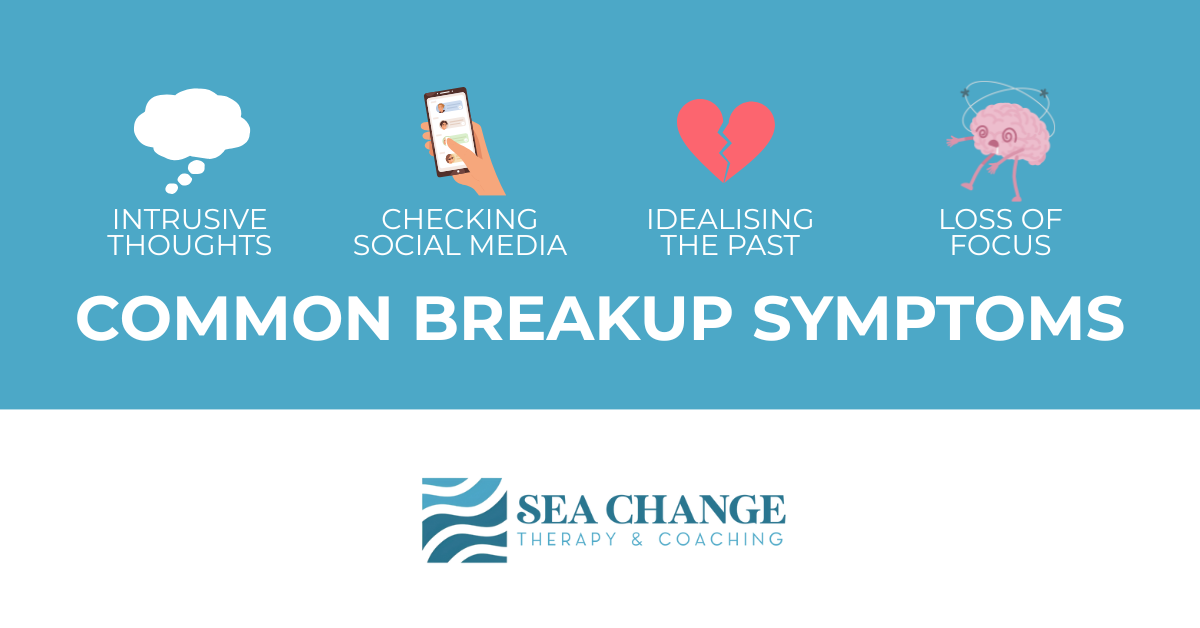
  • Intrusive thoughts about your ex
  • A constant urge to reach out or check social media
  • Idealising the relationship in hindsight
  • Feeling like you’ll never move on

This isn’t weakness. It’s biology.

And that’s why trying to “move on” with logic alone rarely works.


So how do you actually get over your ex?

The first step is understanding that emotional recovery isn’t just about time passing. It’s about what you do with that time. And that’s where coaching comes in.


At Sea Change Therapy & Coaching, we specialise in helping high-functioning professionals navigate the emotional chaos of breakups and divorce. Through a powerful blend of coaching and therapeutic techniques – including HeartMath® and Advanced Thought Field Therapy (TFT-Adv) – we help you:

  • Regulate your nervous system (so you can think clearly again)
  • Process emotional triggers (so you’re not blindsided by a song, a scent, or a memory)
  • Rewire unhelpful beliefs (like “I’ll never find someone else”)
  • Rebuild your confidence, clarity and self-worth

This isn’t “talk therapy.”

It’s structured, focused, and designed to get you feeling better – fast.

It’s not about forgetting them. It’s about remembering you.

A breakup isn’t just the loss of a partner – it’s often the loss of a future you imagined, an identity you built, and a sense of safety in the world. That’s a lot to grieve. But the goal isn’t to erase the past – it’s to reclaim your power in the present.

With the right support, it’s not only possible to let go of your ex – it’s possible to grow into a version of yourself that feels stronger, clearer, and more aligned than ever before.

If you’re ready to stop obsessing and start healing…

Book your free 30-minute Breakthrough Call

Let’s get you feeling like you again.

Categories
Blog

Breakup Brain: Why You Can’t Think Straight – and How to Get Your Clarity Back

Ever found yourself staring into space, forgetting simple things, or second-guessing every decision since your breakup?


You’re not going mad. You’re not weak.

You’re experiencing what many call Breakup Brain – and there’s a scientific reason behind it.

Breakups don’t just break your heart. They hijack your brain.


What Is ‘Breakup Brain’?

After a relationship ends – especially one that was emotionally intense or long-lasting – your brain and body enter a state of crisis. The loss of connection, routine, safety, or identity can trigger a full-blown stress response.

Your nervous system doesn’t know the difference between emotional threat and physical danger. To your brain, this is survival.


This is why so many people report:

  • Brain fog and forgetfulness
  • Trouble concentrating at work
  • Obsessive thoughts about their ex
  • Sleepless nights and intrusive memories
  • Struggling to make even small decisions

This isn’t just heartbreak. It’s your brain in threat mode.

 The Neuroscience Behind It

Studies show that heartbreak activates the same regions of the brain associated with physical pain, addiction, and withdrawal. One key area involved is the anterior cingulate cortex – the same region activated when you experience physical injury.

You’re also dealing with a chemical crash.

During a relationship, your brain produces “feel-good” chemicals like dopamine, oxytocin, and serotonin. After a breakup, those chemical levels plummet, leaving you in an emotional and cognitive slump.

That’s why you:

  • Feel depleted
  • Struggle to focus
  • Replay memories obsessively
  • Try to get “closure” (even if it harms you)

This is biology – not weakness.


Why Clarity Is So Hard (But So Important)

In the middle of emotional upheaval, clarity feels miles away.

But here’s the twist: the biggest, most life-altering decisions – around finances, children, housing, legal proceedings – are often made during this fog.

Which is exactly why having the right support matters.

When your nervous system is dysregulated, your prefrontal cortex – the part responsible for logic, reason, and decision-making – goes offline. In other words:

You can’t think straight while your system is in survival mode.


How Coaching Can Help You Get Your Clarity Back

This is where Breakup & Divorce Coaching comes in.

Not to dwell on the pain, but to help you stabilise, regulate, and refocus.

At Sea Change Therapy & Coaching, we use science-backed techniques such as:

  • Advanced Thought Field Therapy (TFT-Adv)
    • A powerful psychosensory tool that helps calm emotional distress at the source. It can reduce feelings of anxiety, panic, and obsessive thinking in minutes.
  • HeartMath Techniques
    • A clinically validated method to bring your heart and brain back into coherence. It helps restore calm, improve emotional regulation, and support clearer thinking – even in the most stressful circumstances.
  • Strategic Coaching Conversations
    • We guide you to untangle your thoughts, challenge distortions, and rebuild your inner confidence. Our sessions are practical, goal-focused, and emotionally intelligent.

You Deserve to Feel Clear, Not Cloudy

You don’t have to stay stuck in the fog.

You don’t have to navigate this alone.

With the right support, your nervous system can regulate.

Your confidence can return.

And your clarity can lead the way forward.

Book a free 30-minute Breakthrough Call today

Whether you’re newly separated or months down the line, we can help you get back to clarity, confidence and control.

 www.seachangetherapyandcoaching.com

Categories
Blog

Why a Breakup & Divorce Coach Can Save You Time, Stress – and Money

“Divorce isn’t just a legal process – it’s an emotional transformation.”
– Donna Garratty, Breakup & Divorce Coach

When you’re facing the end of a relationship or marriage, there’s a lot to consider. Most people understand the need for a solicitor. Some work with a financial planner. But when you hear the term divorce coach, it’s normal to pause and wonder:

“What exactly do they do – and do I really need one?”

The answer? Not only can a breakup and divorce coach provide emotional clarity and practical support, but they may also save you time, money, and avoidable mistakes in the process.

Here’s how.

1. It’s Not Legal Advice or Financial Advice – It’s Something Just as Important

A coach doesn’t replace your solicitor or financial adviser – but they complement them beautifully.

Think of it like this:

Service Focus
Solicitor Legal rights and representation
Financial Adviser Finances, pensions, settlements
Breakup & Divorce Coach Emotions, mindset, practical clarity

We’re the bridge between emotion and action. We support you before, during, and after your legal and financial appointments – so you don’t spiral, stall, or second-guess every move.

2. We Save You Money on Legal and Professional Fees

Many people use their solicitor as their sounding board. They vent, seek reassurance, or get stuck in indecision – and they do it at £250+ per hour.

A good divorce coach reduces the emotional overwhelm and decision fatigue that leads to this.

✅ You prepare for meetings in advance
✅ You communicate more clearly and concisely
✅ You reduce the time (and money) spent on unnecessary calls and emails
✅ You’re less likely to escalate conflict, delay proceedings or need costly interventions

Real story: One client came to us after spending thousands in solicitor fees – not because their case was complex, but because every interaction became an emotional therapy session. Their solicitor was doing their job, but it wasn’t legal advice they needed in that moment – it was emotional clarity. Within two coaching sessions, the client was calmer, more focused, and able to approach legal meetings with clarity and purpose. As a result, their legal costs stopped spiralling – and their solicitor could focus on progressing the case efficiently.

3. We Help You Avoid Costly Mistakes

Breakups are emotional minefields. That’s where many people make poor decisions:

  • Agreeing to things out of guilt or fear

  • Refusing fair offers to “punish” an ex

  • Failing to protect themselves or their children’s wellbeing

  • Burning bridges they later regret

A coach helps you see clearly when your emotions are clouding your judgement. We’re not here to tell you what to do – we’re here to help you do it well.

4. We Help You Protect Your Mental Health (and Your Profession)

Divorce is one of the most stressful life events (second only to the death of a loved-one), and it doesn’t stay neatly contained outside of work hours.

Professionals and business owners often keep going on the surface, but silently struggle underneath. Stress, sleepless nights, and emotional overload can:

  • Damage your concentration and productivity

  • Lead to burnout or mental health decline

  • Strain client relationships and decision-making

Coaching provides confidential, non-judgemental support that helps you cope better, stay resilient, and keep functioning well in your role – even through the chaos.

5. We Help You Move On Faster and Better

Breakup coaching isn’t just about surviving your divorce – it’s about designing life after it.

We support you to:

  • Rebuild confidence

  • Set new boundaries

  • Let go of emotional baggage

  • Create a new future on your terms

That means fewer repeat patterns, fewer setbacks, and a much smoother recovery.

💡 What Makes Sea Change Therapy & Coaching Different?

We specialise in working with professionals, business owners, and high-achievers who want to:

  • Navigate the emotional rollercoaster without falling apart

  • Make wise decisions and avoid long-term regrets

  • Recover faster and stronger – both personally and professionally

We offer:
✅ 1-1 coaching tailored to your needs
✅ Specialist support for complex issues like high-conflict divorce or abuse
✅ Online and in-person sessions with flexible timing
✅ Confidential, practical, and focused help – no fluff

📞 Want to talk?

Book a free, confidential 30-minute Breakthrough Session and find out how we can support you through your breakup or divorce – emotionally, practically, and strategically:
👉 www.seachangetherapyandcoaching.com